

Under the Renewable Energy for Resilient Agri-Food Systems (RERAS)* project, Norwegian Ambassador Her Excellency Ms. Dagny Mjøs and UNDP Nepal Resident Representative Ms. Kyoko Yokosuka visited the Jumla cluster from 17–19 November 2025. The mission aimed to monitor the ongoing progress and achievements of how renewable energy and climate resilient agriculture are improving the lives of remote communities by linking it to local markets and midday meals of schools in Tatopani, Patarasi and Chandannath, three municipalities of Jumla.
This delegation included Norwegian Embassy Counselor Mr. Einar Telnes; World Food Programme (WFP) Deputy County Director Mr. Niels Balzer; UNDP Portfolio Manager Mr. Pragyajan Yalamber Rai; RERAS/UNDP Project Manager Shiva Kumar Shrestha; MoALD Under Secretary Mr. Lal Kumar Shrestha; Tatopani Rural Municipality Chairperson Mr. Nanda Prasad Chaulagain; Patarasi Rural Municipality Chairperson Mr. Purna Singh Bohara, and other representatives from UNDP, WFP, Alternative Energy Promotion Centre (AEPC), Asian Development Bank (ADB) and LI-BIRD.
The delegation inaugurated an electric-powered lift irrigation scheme constructed by RERAS with technical support from AEPC in Dhaulapani. This system is powered by Girikhola Micro Hydropower Plant (MHP), where RERAS supported for capacity development for smoother operation. This irrigation system currently irrigates more than 5,500 apple trees, benefiting 97 households. LI-BIRD is providing technical support to farmers to establish the area into a model apple orchard for demonstration and farmer to farmer learning. The team observed the apple orchard and interacted with farmers who expressed their gratitude for receiving reliable irrigation and technical guidance. LI-BIRD, through the Farmer Field School (FFS) approach, is working with three farmers groups to build their skills in orchard management. Farmers have developed and follow an annual orchard management calendar covering training, pruning, manuring, irrigation, mulching, pest management, pollination and more.

Looking ahead, RERAS plans to transform this orchard into a fully integrated model orchard, equipped with precision technology-sensor-based advisory systems for irrigation and soil nutrient management, intercultural operations, under the technical leadership of UNDP and Gham Power.
The delegation was particularly impressed by the work of Hanku Community Seed Bank, operated by the Dhauligaad Agriculture Cooperative in Tatopani Rural Municipality with support from RERAS through LI-BIRD. The community seed bank has made remarkable progress in conserving, cultivating, processing, and marketing indigenous crops. Through RERAS coordination, the cooperative is linked to the Home-Grown School Feeding (HGSF) Programme, supplying locally produced vegetables and indigenous crops to 10 local schools across Tatopani Rural Municipality.
|
|
|
|
The delegates with the cooperative members at Hanku Community Seed Bank (Left), LI-BIRD Executive Director Mr. Bharat Bhandari explaining the role of the Hanku Seed Bank on conservation and promotion of unique local crop diversity (Right). Photo: Niranjan Pudasaini, LI-BIRD. |
|


During the interaction, Cooperative Chairperson Ms. Kabita Jaisi shared the cooperative’s inspiring journey towards local crop conservation and explained how RERAS support has been instrumental to strengthen and diversify cooperatives businesses by enhancing their capacity in production, aggregation, processing, and marketing of local crop seeds and products. She emphasized that the community seed bank also provides quality seeds to farmers to improve yields, while its participation in school meal program ensures a reliable local market for their produce.
The cooperative has achieved an impressive 13-ton turnover of local crops, of which 7 tons were supplied to local schools benefiting 657 students. It also sold 3 tons of seeds including beans, millet, carrot and potato to a seed company and neighboring municipalities. Ms. Jaisi proudly shared that the cooperative’s annual turnover has now exceeded NPR 2 million, making it financially viable. The cooperative directly benefits 350 producer farmers (297 women) and their families by enabling them to grow and sell their agricultural products, thus enhancing their economic empowerment and social cohesiveness.
Additionally, the Honorable Minister Mr. Binod Kumar Shah from the Ministry of Land Management, Agriculture, and Cooperative (MoLMAC) Karnali Province visited the Hanku Community Seed Bank together with Secretary Mr. Sanjib Karna, and ministry official. The Minister and his team observed the seed bank, interacted with its management committee and LI-BIRD team and learned about the progress and challenges of CSB. Honorable Minister Shah praised the work of community seed banks work in conserving and promoting unique indigenous crops and wished for further achievements of the Hanku Seed Bank in Jumla, with positive impacts on community livelihoods. He also suggested developing a plan to leverage provincial and local government resources for scaling the seed bank’s work in the future.
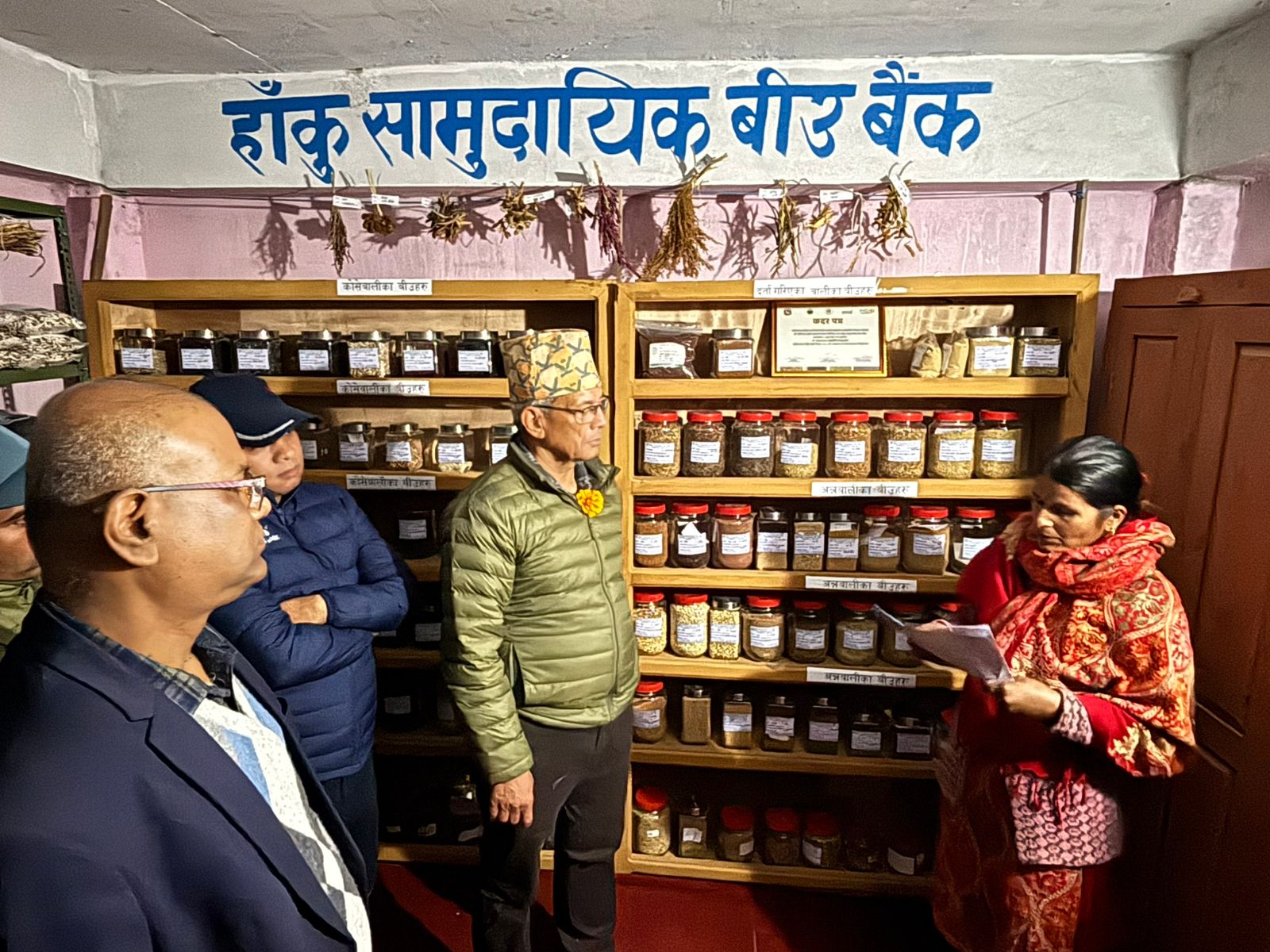
LI-BIRD Executive Director Mr. Bharat Bhandari highlighted the Hanku Community Seed Bank as a strong example of a locally led approach to managing agrobiodiversity while promoting social and economic empowerment of communities and strengthening community climate resilience. He emphasized that this approach is effective, scalable and can be widely replicated in partnership with local governments.
The mission team visited Kalika Elementary School in Hiyan Khola, Tatopani Rural Municipality, where they interacted with school authorities, management committees and parents to learn about the outcomes of the home-grown school meal program. RERAS, with technical support from WFP, supported the construction of a clean kitchen and provided essential equipment to ensure smooth implementation execution of midday meal program in coordination with the municipality.
 |
|
|
A group photo at Kalika Elementary School entrance of the school visiting team (left). School students enjoying a nutritious school meal (right) (Photos: UNDP) |
|
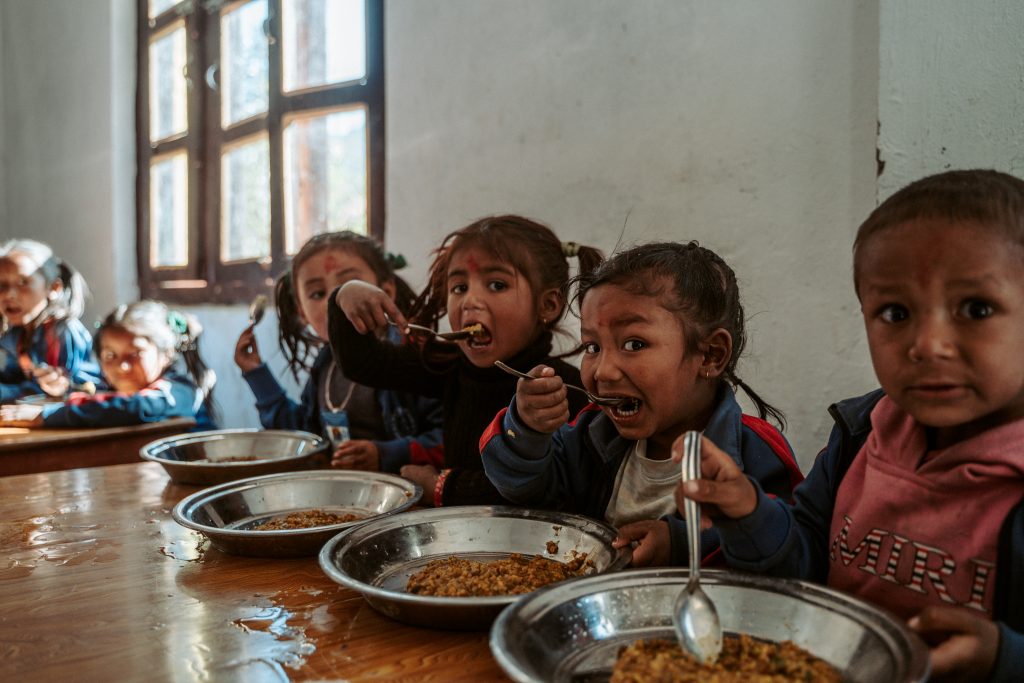
The school has collaborated with the women-led Dhauligadh Agriculture Cooperative to supply locally grown vegetables and grains. Through RERAS support, LI-BIRD assists the cooperative in production, collection, processing, and regular supply of meal items as per the school menu. A total 80 students (51 girls) up to grade five are benefited from nutritious daily meals, supporting their daily dietary needs and helping reduce dropout rates.
Tatopani Municipality Chairperson Mr. Nanda Prasad Chaulagain appreciated RERAS support and reaffirmed the Municipality’s commitment to sustaining the initiative. The school management team, teachers and parents expressed their happiness and gratitude for the strengthened coordination that has made the programme more effective.
Visiting diplomats and dignitaries from donor agency, implementing partners and local and provincial governments expressed satisfaction with the positive, ground-level changes achieved through the project. They emphasized the strong collaboration with local government and the active participation of community members as key drivers of these successes.
*Renewable Energy for Resilient Agri-Food Systems (RERAS) is a joint initiation of the Government of Nepal and United Nations development Programme, funded by the Royal Norwegian Embassy. The UNDP led project is implemented in partnership with Alternative Energy Promotion Centre (AEPC), World Food Programme (WFP), International Centre for Integrated Mountain Development (ICIMOD) and Local Initiatives for Biodiversity, Research and Development (LI-BIRD), in close collaboration with local government and other national institutions in 20 municipalities across Sudurpaschim, Karnali, Bagmati and Madesh provinces.
This article is reviewed by Ms. Himashree Malla, Communication Associate, RERAS UNDP.
********