
Description
Foxtail millet (popular as Kaguno in Nepal) is a highly nutritious crop that grows well even in dry weather, making it an important contributor to food security. Yet, despite these valuable qualities, foxtail millet gradually disappeared from farmers’ fields over the past few decades. As food habits changed, more people started consuming rice over traditional foxtail millet. At the same time, processing technology favored rice production. Rice milling became much easier with the availability of local machines, while processing foxtail millet remained very difficult, labor-intensive and time-consuming, requiring hours of manual work. As a result, many farmers abandoned foxtail millet and shifted to maize, believing it to be a more practical choice.
LI-BIRD recognized that despite being abandoned by farmers, the traditional crop retained substantial advantages. Foxtail millet is drought-tolerant, less susceptible to diseases, has early maturity, highly nutritious, and according to farmers, suffers far less damage from monkey attacks. To overcome the challenge of tedious processing, LI-BIRD introduced specialized threshing machine to the community. This simple innovation dramatically reduced the time and effort required to process the grain, encouraging farmers to cultivate the foxtail millet once again. The crop that many had nearly forgotten began returning to the fields across the community.
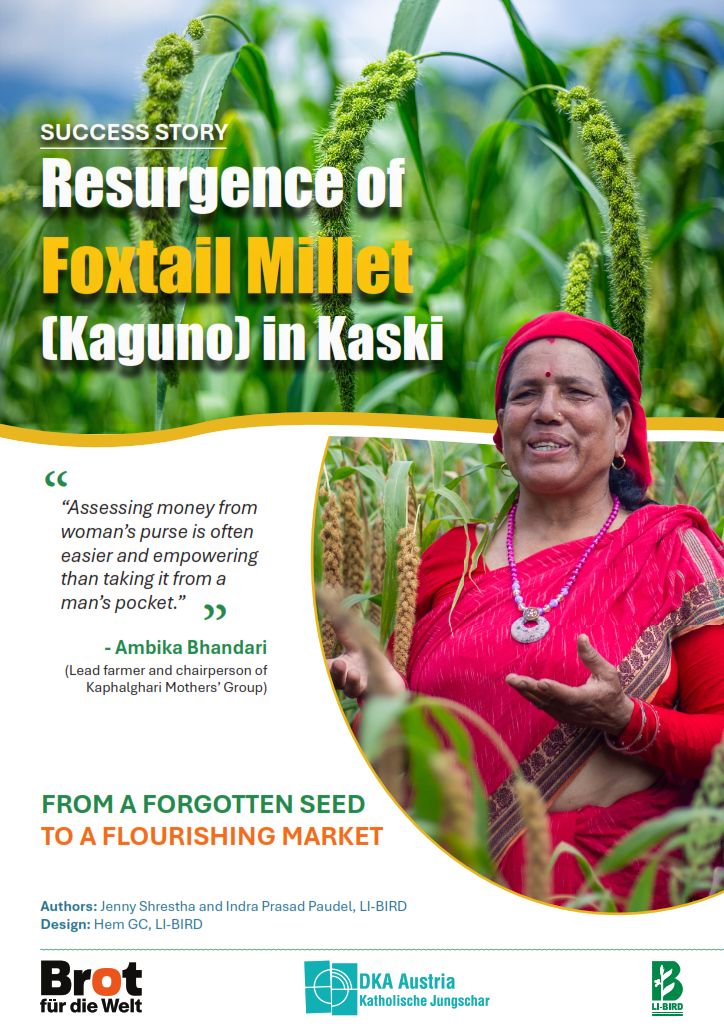
Ambika Bhandari (55), a lead farmer from Pokhara Metropolitan City, Ward No. 28 and Chairperson of the Kaphalghari Mothers’ Group became one of the key contributors behind this revival. Through her leadership and collaboration with LI-BIRD, foxtail millet was reintroduced in her community. What was once a forgotten and undervalued crop has now become an important source of income for local households, improving livelihoods and restoring farmers’ confidence.