
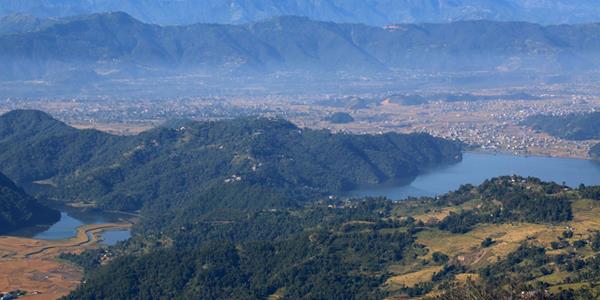
The Lake Cluster of Pokhara Valley (LCPV), a Ramsar Site declared on 2 February 2016, includes basins of nine lakes (Phewa, Kamalpokhari, Gunde, Khaste, Neureni, Dipang, Maidi, Begnas, and Rupa) in Pokhara Valley in the central section of the Lower Himalaya (28°08’02” N 84°59’18” E), which together have 261.6 km² of basin and 8.97 km² of water cover (2019). It is endowed with rich agricultural and aquatic biodiversity. Cultivating local agrobiodiversity offers various benefits to farmers, including nutritious and safe food, greater resilience to biophysical shocks and climate change, and it also promotes local culture. Despite these benefits, the loss of agrobiodiversity, fish species, and wetland habitat, and pollution continued unabated in the LCPV. Low productivity of local agrobiodiversity crops and fish species, low consumer awareness regarding the nutritive value of local agrobiodiversity, limited diversification of marketable agrobiodiversity products, and government policy favouring modern varieties are some of the underlying causes of the loss of agrobiodiversity.
To improve the situation, LI-BIRD, with financial support from the Darwin Initiative (Department for Environment, Food and Rural Affairs, UK), implemented a three-year project “Market-Led Approach to Sustainable Management of Agrobiodiversity for Livelihood Outcomes” in the LCPV area from June 2019 to May 2022. The project aimed to scale up the market-led approach, Unified Landscape Branding (ULB), under which local produce, including place-based services (homestays) from in and around the Lake Cluster of Pokhara Valley (LCPV), would be marketed under a unique label/brand. A certain percentage of the profit from the business will be reinvested in the sustainable management of biodiversity in the region. The project aimed to benefit 3,000 smallholder farmers in the area and to contribute to the conservation of the natural habitat of lakes, which is at the centre of wetland biodiversity. The project forged multi-stakeholder partnerships with public entities (Pokhara Metropolitan, Annapurna, and Rupa Rural Municipalities; Provincial Government, especially the Ministry of Land Management, Agriculture, and Cooperatives; Ramsar Management Authority; Machhapuchhre Development Organisation), private sector (Lekhnath Chamber of Commerce and Industry; The Bazaar), cooperatives (Panchadham Agriculture Development Cooperative; Rupa Lake Restoration and Fisheries Cooperative), and community networks such as Jaibik Shrot Samrakshan Abhiyan to mobilise local resources and foster stewardship for sustainable management of agricultural and wetland biodiversity.
The key achievements of the project included:
- Positive income growth was registered in a range of 16.4% (coffee), 24% (fresh vegetables), 34% (shiitake mushrooms), and 52.4% (honeybees), and up to 157% (foxtail millet).
- The project established a Biodiversity Information Centre (BIC) for showcasing a collection of different local crops, a demonstration of indigenous knowledge/tools, and a collection of popular and rare orchids.
- A total of 42.5 ha of conservation area was allocated at four lakes, in coordination with governments and communities.
Project Details
Countries
Nepal
Working district
Kaski
Province | Municipality
Duration
2019 - 2022
Partners
Annapurna Ruralmunicipality, Lekhnath Chamber of Commerce and Industry, Machhapuchhre Development Organization (MDO) Kaski, Ministry of Land Management, Agriculture and Cooperative, Panchadham Agriculture Development Cooperative, Phewa Watershed Ecosystem Management Board, Pokhara Metropolitan City, Ramsar Management Authority, Rupa Ruralmunicipality, The Bazaar
Funded by
Darwin Initiative