

The Agrobiodiversity and Local Products Exhibition Fair 2082 was organized on 22 November 2025 in Budhinanda Municipality, Kolti, Bajura. Supported by the Renewable Energy for Resilient Agri-Food Systems (RERAS)* project, led by UNDP and implemented on the ground by Local Initiatives for Biodiversity, Research and Development (LI-BIRD), the event brought together five local government representatives, development partners, community groups, cooperatives, and farmers. The fair celebrated and promoted the rich heritage of indigenous crops and traditional food systems of the Karnali corridor (Khulalu-Hilsa, Humla), adjoining regions of Karnali and Sudurpashchim Provinces.
The fair served as a dynamic platform to showcase local crop diversity, promote indigenous crop varieties, and encourage the exchange of local seeds and traditional knowledge. It emphasized on food and nutrition security, climate resilience, and sustainable agriculture. Additionally, the fair highlighted local crop diversity, showcased traditional food products, facilitated the exchange of seeds and knowledge, and strengthened collaborative governance for agrobiodiversity conservation.

The formal program was chaired by Mr. Janak Kumar Bohara, Mayor of Budhinanda Municipality and graced by Honorable Mr. Kamal Bahadur Shah, Chief Minister of Sudurpashchim Province as the chief guest. Special guests included Mr. Naresh Kumar Shahi, Former Minister of Economic Affairs, and Ms. Juna Dani, Member of the Provincial Assembly, Sudurpashchim Province. Other notable attendees included Mr. Santosh Kumar Shah, Act. Chief Administrative Officer, Budhinanda Municipality; Mr. Govinda Bahadur Malla, Chairperson, Himali Rural Municipality; and Mr. Ram Bahadur Bohara, Deputy Mayor, Budhinanda Municipality. Likewise, RERAS project personnel Mr. Bishal Paudel (RERAS, UNDP), Lokesh Kumar Thapa (RERAS, LI-BIRD), Shambhu Basnet (RERAS, LI-BIRD), Kabi Raj Awasthi (RERAS, LI-BIRD), along with the field teams of partner organizations of LI-BIRD and Alternative Energy Promotion Center (AEPC)/Central Renewable Energy Fund (CREF) were also present.
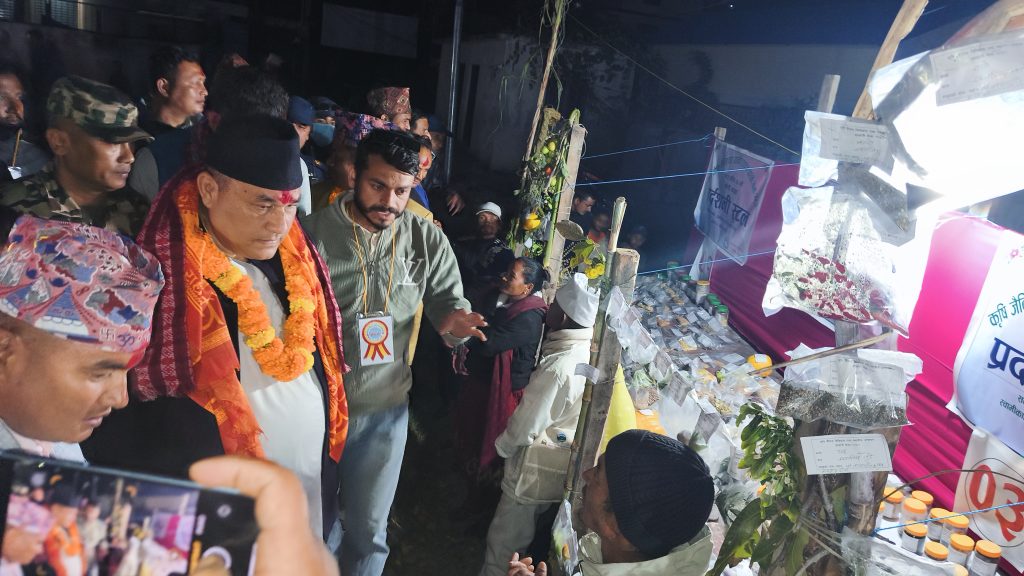
The fair featured 12 exhibition stalls, including 10 dedicated agrobiodiversity stalls representing Budhinanda Municipality (Bajura), Jagannath Rural Municipality (Bajura), Swamikartik Khapar Rural Municipality (Bajura), Himali Rural Municipality (Bajura), and Khatyad Rural Municipality (Mugu). A remarkable 1,060 unique local crop samples were exhibited, making it one of the most comprehensive community-led biodiversity exhibitions in the region.
 |
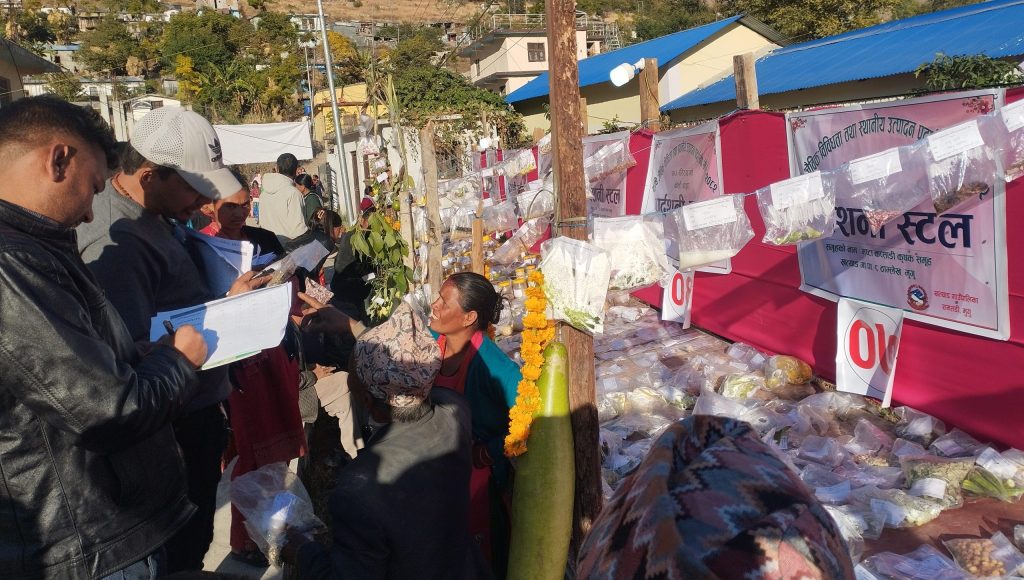 |
| (Left) Programme Officer Mr. Kabiraj Awasthi, LI-BIRD facilitating stall observation for guests during the event. (Photo: Himal B.K.) (Right) Stall Evaluation Team assessing the stall. From the left; Mr. Dipak Karki, JTA of Budhinanda MC, Mr. Rukshal Hamal, PO of INF Nepal. (Photo: Ram Chandra Upadhaya) | |
A dedicated stall from Budhinanda Municipality displayed traditional recipes from local grown indigenous crops, including Kagunoko Kheer, Gahun and Kodo Sel Roti, Kodoko Namkin, Kodoko Momo, local Tamatarko Chatni, local Simiko Tarkari, and Marseko Laddu.
Here are a few crop diversity exhibition highlights:
- Swamikartik Khapar RM exhibited the highest diversity: 293 varieties of 103 crops, represented by Kerabari and Janajagriti Farmers’ Groups.
- Jagannath RM displayed 238 varieties of 97 crops through Uccha Himali and Triveni Pilichaur Farmers’ Groups.
- Khatyad RM (Mugu) showcased 228 varieties of 67 crops via Masta Kapasadi and Mahadev Masta Farmers’ Groups.
- Himali RM presented 161 varieties of 82 crops through Hamro and Budhinanda Farmers’ Groups.
- Budhinanda Municipality showcased 140 varieties of 62 crops through Pragatisheel and Kalegad Farmers’ Groups.
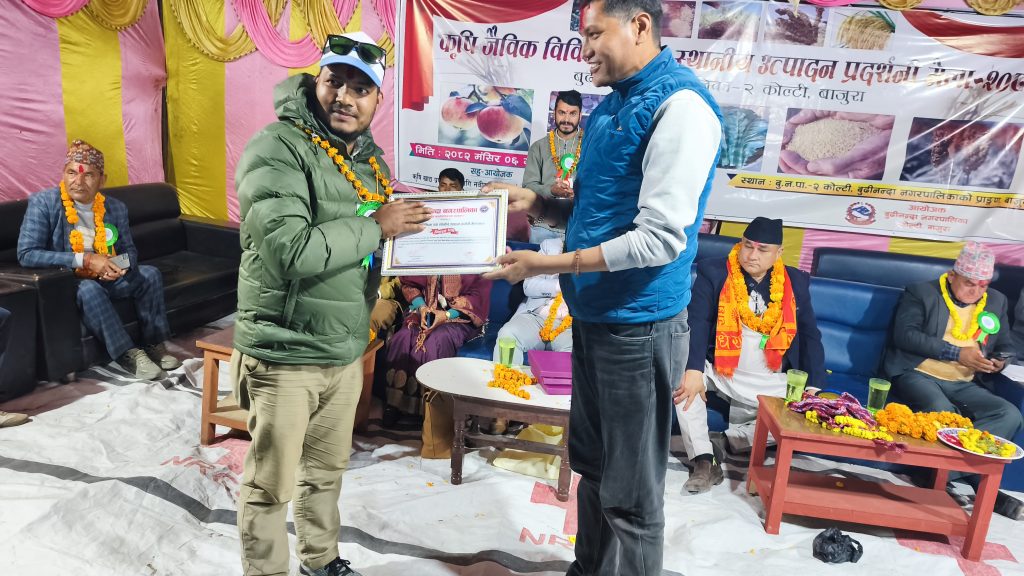
The Knowledge Corner, facilitated by RERAS together with LI-BIRD, provided practical insights on climate-resilient indigenous crops, renewable energy-based agricultural technologies, seed conservation practices, climate-resilient agriculture, and leading towards strengthening food and nutrition security. Based on the stall evaluation, awards were presented to recognize excellence. The 1st Prize (NPR 7,000) went to Janajagriti Krishak Samuha, Swamikartik Khapar RM–4; the 2nd Prize (NPR 5,000) to Uchcha Himali Krishak Samuha, Jagannath RM–1; and the 3rd Prize (NPR 4,000) to Budhinanda Krishak Samuha, Himali RM–4. These awards acknowledged the communities efforts in preserving and promoting biodiversity by exhibiting rich local crop variety and sharing associated knowledge during the event.
More than 650 participants including farmers, youth, students, entrepreneurs, technicians, and representatives from development partners visited the fair. Cultural performances such as Deuda songs and traditional dances added vibrance, reflecting the deep connections between biodiversity, food culture, and social identity in Sudurpashchim.
The leadership shows high level of commitment to Heritage and Resilience of such event throughout the observation. Honorable Chief Minister Mr. Kamal Bahadur Shah emphasized that indigenous crops are key to climate-resilient agriculture, stronger local identity, and sustainable nutrition.
|
|
|
Former Minister Mr. Naresh Kumar Shahi highlighted the dedication of farmers who have conserved seeds through generations. Provincial Assembly Member Ms. Juna Dani appreciated the strong participation of women and youth, noting that local seed conservation ensure long-term food security.
Mayor Mr. Janak Kumar Bohara reaffirmed the municipality’s commitment to expanding such fairs and prioritizing biodiversity conservation. The Chair emphasized that conserving indigenous crops is essential for preserving local food heritage and reducing dependency. He thanked the RERAS team for organizing a meaningful, well-participated event and appreciated RERAS and UNDP for implementing a project that is highly relevant and impactful in Bajura and Mugu.
The Agrobiodiversity and Local Products Exhibition Fair reinforced a shared vision to build resilient, sustainable, and biodiversity-rich agri-food systems that secure the future of mountain communities. Rooted in local knowledge and strengthened by community leadership, the fair demonstrated how indigenous crops and renewable energy driven agriculture can shape a more resilient and food secure future.
|
|
|
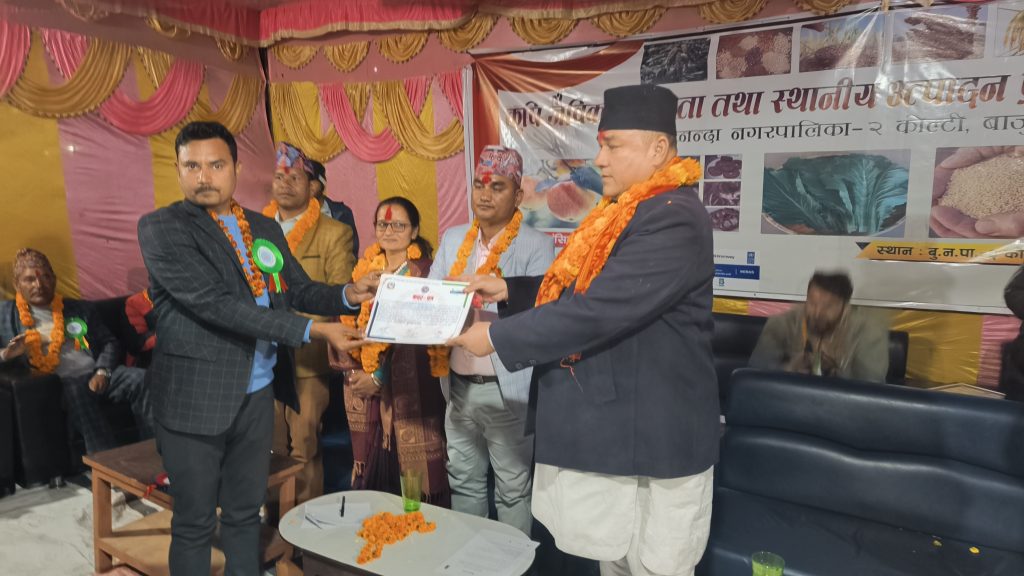
| (Left) Mr. Bishal Paudel, Cluster Coordination Analyst, RERAS, UNDP receiving a Letter of Appreciation from Hon. Mr. Kamal Bahadur Shah. (Photo: Himal B.K.). (Right) Mr. Lokesh Kumar Thapa, Cluster Coordinator, RERAS, LI-BIRD receiving a Letter of Appreciation from Former Minister Naresh Kumar Shahi. (Photo: Khim Bahadur Oli) | |
*Renewable Energy for Resilient Agri-Food Systems (RERAS) is a joint initiation of the Government of Nepal and United Nations development Programme, funded by the Royal Norwegian Embassy. The UNDP led project is implemented in partnership with Alternative Energy Promotion Centre (AEPC), World Food Programme (WFP), International Centre for Integrated Mountain Development (ICIMOD) and Local Initiatives for Biodiversity, Research and Development (LI-BIRD), in close collaboration with local government and other national institutions in 20 municipalities across Sudurpashchim, Karnali, Bagmati and Madesh provinces.
This article is reviewed by Mr. Niranjan Pudasaini, Strategic Programme Lead, RERAS, LI-BIRD and Ms. Himashree Malla, Communication Associate, RERAS, UNDP