
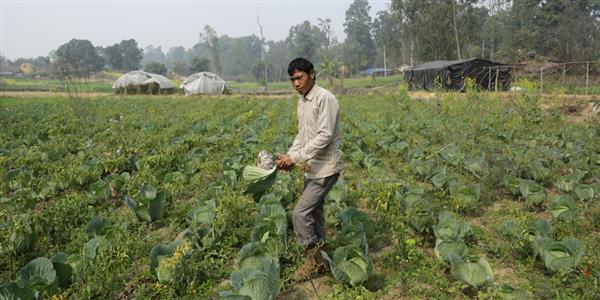
The SAKSHAM Project was initiated to improve the livelihoods and well-being of marginal and climate-vulnerable families in Kanchanpur and Doti districts of Sudurpaschim Province, Nepal. The project aimed to do so by organising and capacitating beneficiaries, providing them with skills, resources, and collaborating with local governments and other key stakeholders to create an environment to access support and services.
The objectives of the project were to:
- diversify the project and improve food and nutrition security
- create income opportunities for targeted communities; and
- improve climate change adaptation and disaster risk management capacities of local governments, institutions, and communities.
The Project worked with resource-poor, marginal, and landless Freed Kamaiya, People with Disabilities (PwD), returnee migrants, single women, and smallholder farming households primarily living below the poverty line. More than 60% beneficiaries were women among individual beneficiaries.
The key achievements of the project include:
i) Formation of 162 farmer groups, and they were mobilized and capacitated to roll out project interventions.
ii) Reduction of food shortage of the targeted HHs from 8 to 5.7 months.
iii) Increased vegetable production of households by 96.8% with an average production of 875 kg per household.
iv) Establishment of four climate-resilient villages in collaboration with provincial governments. Recognizing the success of this model, the Ministry of Land Management, Agriculture, and Cooperatives (MoLMAC) of Sudurpaschim Province has incorporated CSVs into its annual development plan, aiming to replicate the approach in collaboration with LI-BIRD across nine districts in the province.
v) Average income of beneficiary households increased from NPR 5,000 to NPR 10,000 through project interventions.
vi) Dietary diversity of households increased from 3.1 in the baseline to 5.2.
vii) Supported the establishment and rehabilitation of 38 irrigation schemes in collaboration with local governments that included 30 T-boring, 2 solar-based irrigation, 2 trolley-based solar irrigation, 2 sunflower portable solar pumps, 1 irrigation canal, and 1 irrigation pond, providing a year-round irrigation facility to 152 hectares of land area, benefiting 1,260 households.
viii) Over 100 climate champions developed for grassroots advocacy on climate change adaptation and disaster risk reduction.
ix) The project promoted varieties of climate-resilient crops like Rice (Radha-4, Sukkha-3, Bahuguni-2, and Hardinath-4); Wheat (BL-4341, Zinc-2, and Swargadwari); Maize (Rampur, Composite and Arun-4); Potato (Tharu Aalu and Axona); and Vegetables (Lettuce, beetroot, elephant yam, Amaranthus, drumstick, cassava, orange-fleshed sweet potato, water spinach, and kangkong).
x) Strengthened local market systems through the establishment of a collection centre in Doti and a local Haat Bazar in Kanchanpur in collaboration with local governments.
The project worked with 9 cooperatives and 3 community seed banks (CSBs) to enhance their operational and service delivery capacities. Cooperatives have played a key role in easing access to agriculture and livestock insurance by managing documentation on behalf of farmers. Through the project, LI-BIRD supported local governments in the development of the Local Disaster and Climate Resilience Plan (LDCRP), Local Disaster and Climate Resilience Framework (LDCRF), and a guideline on leasehold farming. At the provincial level, LI-BIRD also supported the development of a leasehold farming guideline for the Government of Sudurpaschim Province
Project Details
Countries
Nepal
Province
Sudurpaschim
Working district
Kanchanpur, Doti
Municipality
Kanchanpur: Krishnapur MC and Laljhadi RM
Doti: Jorayal RM
Duration
2022 - 2025
Partners
Funded by
The Ministry for Foreign Affairs of Finland through FELM Nepal
Household Coverage
Direct-3500 and Indirect-5400
Contact Person
Indeshwar Mandal
E-mail: imandal@libird.org