
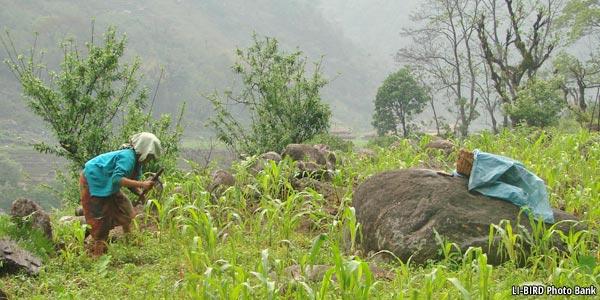
The project studied Conservation Agricultural Production Systems (CAPS) managed by Chepang communities in the mid-hills of Nepal. It examined the indigenous knowledge and practices followed by Chepang communities on conservation agriculture and scientifically verified some of the promising local practices on-farm and built the capacity of farmers and stakeholders on conservation agriculture practices. By promoting CAPS, the project contributed to the food security of the smallholder farmers in Nepal who endure decreased soil fertility and climatic stresses.
The project, in partnership with the University of Hawaii, carried out participatory action research to identify appropriate climate stress-tolerant practices and crops/varieties. It provided training and organised workshops and visits to share test findings and refine agriculture practices. It supported farmers with various crop seeds and tools.
At the local level, the project coordinated with the Village Development Committees (VDCs) and farmers’ groups while identifying and testing technologies. LI-BIRD coordinated with the Institute of Agriculture and Animal Science (IAAS), TU, while conducting on-farm testing of the agricultural technologies. Students and professors were directly involved in the research process. Internationally, the project had collaborated with the University of Hawaii for the implementation of this project in Nepal.
The key achievements of the project include:
- Three sets of promising CAPS were identified through participatory action research involving the community and researchers.
- Soil quality improved, production increased, and the income of test farmers increased.
- CAPS with legume integration were found to be more profitable than the conventional single-cropping method and are ready to scale out.
Project Details
Countries
Nepal
Province
Working district
Dhading, Gorkha, Tanahu
Municipality
Duration
Oct 2010 - Nov 2014
Partners
University of Hawaii
Funded by
USAID, SANREM CRSP
Household Coverage
Contact Person
E-mail: info@libird.org