
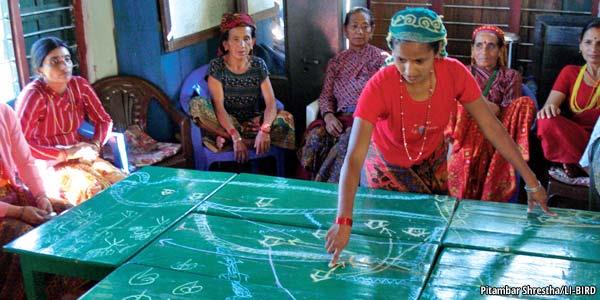
Community-based Biodiversity Management for Resilience was a global project funded by the Food and Agriculture Organization (FAO) of the United Nations under the Benefit Sharing Fund of the International Treaty on Plant Genetic Resources for Food and Agriculture. The project aimed to develop a Strategic Action Plan (SAP) for managing biodiversity through a community-based approach and improving community resilience with the help of Participatory Learning and Action Research (PLAR). It was intended that once SAP was prepared in each partner country, the document would then be used to design new projects and reshape project activities, with a long-term goal of making communities more resilient to climate change. LI-BIRD was responsible for providing technical guidance to in-country partners in research design, data collection and analysis, and write-up of the report; providing support in preparation of the SAP document; and facilitating partners in the design of new project proposals as per the SAP. Being the lead agency, LI-BIRD coordinated with regional coordinators from the respective regions in Asia, Latin America, and Africa. In each country, the respective NGO took the lead with support from a university partner, and one to two CBOs were involved in developing strategic action plans. LI-BIRD was responsible for coordinating partners from different countries, ensuring quality delivery, and reporting to the donor.
In the case of Nepal, the project provided technical support to community organizations in community-based biodiversity management (CBM) activities. It also supported thesis research for two MSc students, provided exposure visits to Community-based Organization and NGO staff and members, and university professionals by inviting them to national and international meetings, and knowledge exchange during PLAR sessions.
The key achievements of the project include:
- 12 Strategic Action Plans (SAPs) designed, one per partner country, for managing biodiversity through a community-based approach and improving community resilience.
- CBM activities promoted in academic institutions, students thesis produced on CBM- and climate change resilience-related topics, a new CBM working modality developed (CBO, NGO, and university collaboration), and knowledge about CBM improved.
Project Details
Countries
Bangladesh, Benin, Brazil, Ecuador, Ethiopia, Guatemala, India, Malawi, Nicaragua, Nepal
Province
Working district
Bara
Municipality
Duration
April 2012 - December 2013
Partners
Bioversity International, Collaborative Programme on Participatory Plant Breeding in Mesoamerica (Guatemala), Federal Rural University of Pernambuco, Federal University of Santa Catarina, M.S. Swaminathan Research Foundation, Mekelle University (Ethiopia), National University of Loja, UBINIG, University of Abomey-Calavi, Wageningen UR/CDI
Funded by
Food and Agriculture Organisation of the United Nations
Household Coverage
Contact Person
E-mail: info@libird.org